Motorcycle Racing Suit Guide: Fit, Leather & Protection
Choosing a motorcycle racing suit is not simply a decision about leather, appearance or price. The right suit depends on construction, protection, certification, fit, riding position, ventilation, intended use and the requirements of your track or event.
Quick Answer:
For dedicated track riding, a properly fitted one-piece racing suit is usually the most straightforward choice because the garment is designed as one integrated system. A two-piece suit can provide greater versatility, but riders must evaluate the jacket-to-pants connection, protection coverage and event rules. Leather remains a common choice for high-performance racing applications because of its abrasion-resistant characteristics, while the actual protection level depends on the complete garment construction, protective components and applicable certification.
How to Choose a Motorcycle Racing Suit
The best racing suit is the one that matches your riding environment, protection requirements and body position rather than simply the one with the most features. Start with the intended use, then compare suit construction, material, protection, fit and certification.
| ✓ Intended Use Identify whether the suit is for track riding, racing, sport riding or mixed use. | ✓ Construction Compare one-piece and two-piece construction. |
| ✓ Material Compare leather and textile construction for the intended application. | ✓ Protection Check the actual protective components and their specifications. |
| ✓ Certification Verify applicable CE requirements and garment classification. | ✓ Fit Evaluate the suit in the actual motorcycle riding position. |
| ✓ Ventilation Consider perforation, airflow and climate. | ✓ Airbag Compatibility Check compatibility if you intend to use an airbag system. |
One-Piece vs Two-Piece Motorcycle Racing Suits
One-piece and two-piece racing suits are not simply different styles. Their construction affects versatility, connection, fit and how the garment functions as a complete protective system.
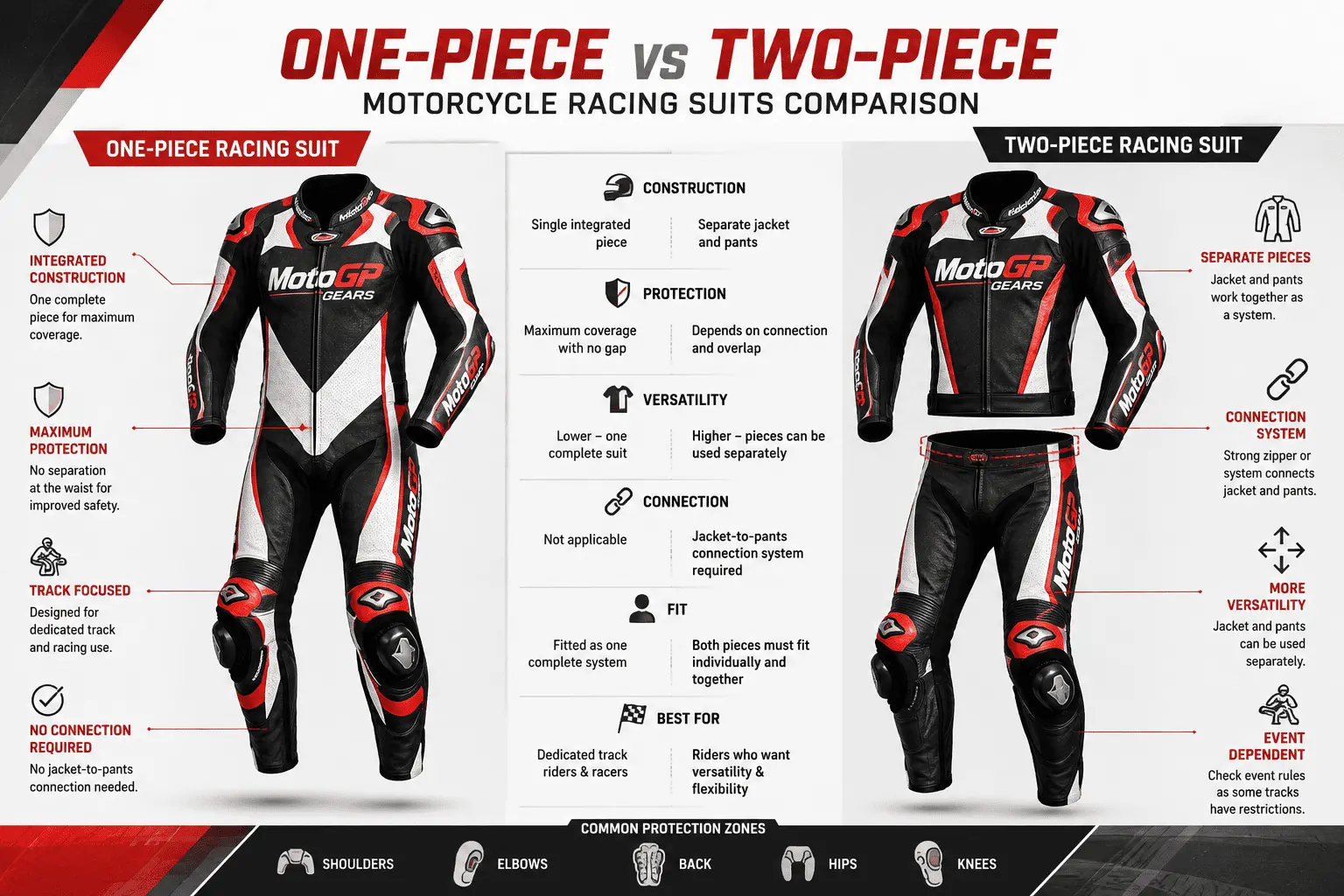
| Factor | One-Piece Racing Suit | Two-Piece Racing Suit |
|---|---|---|
| Construction | Single integrated garment. | Separate jacket and pants designed to work together. |
| Track Use | Common choice for dedicated track riding. | Can be suitable where the event permits the configuration. |
| Versatility | Lower because the complete suit is one garment. | Higher because jacket and pants are separate. |
| Connection | No jacket-to-pants connection required. | Connection system is an important part of the design. |
| Fit | Must be evaluated as one complete body-fitting system. | Both pieces must fit correctly individually and together. |
| Best Starting Point | Dedicated track-focused rider. | Rider who values flexibility between riding applications. |
Expert Tip: Always check your circuit, racing organization or event regulations before assuming that a particular suit configuration is permitted.
Leather vs Textile Motorcycle Racing Suits
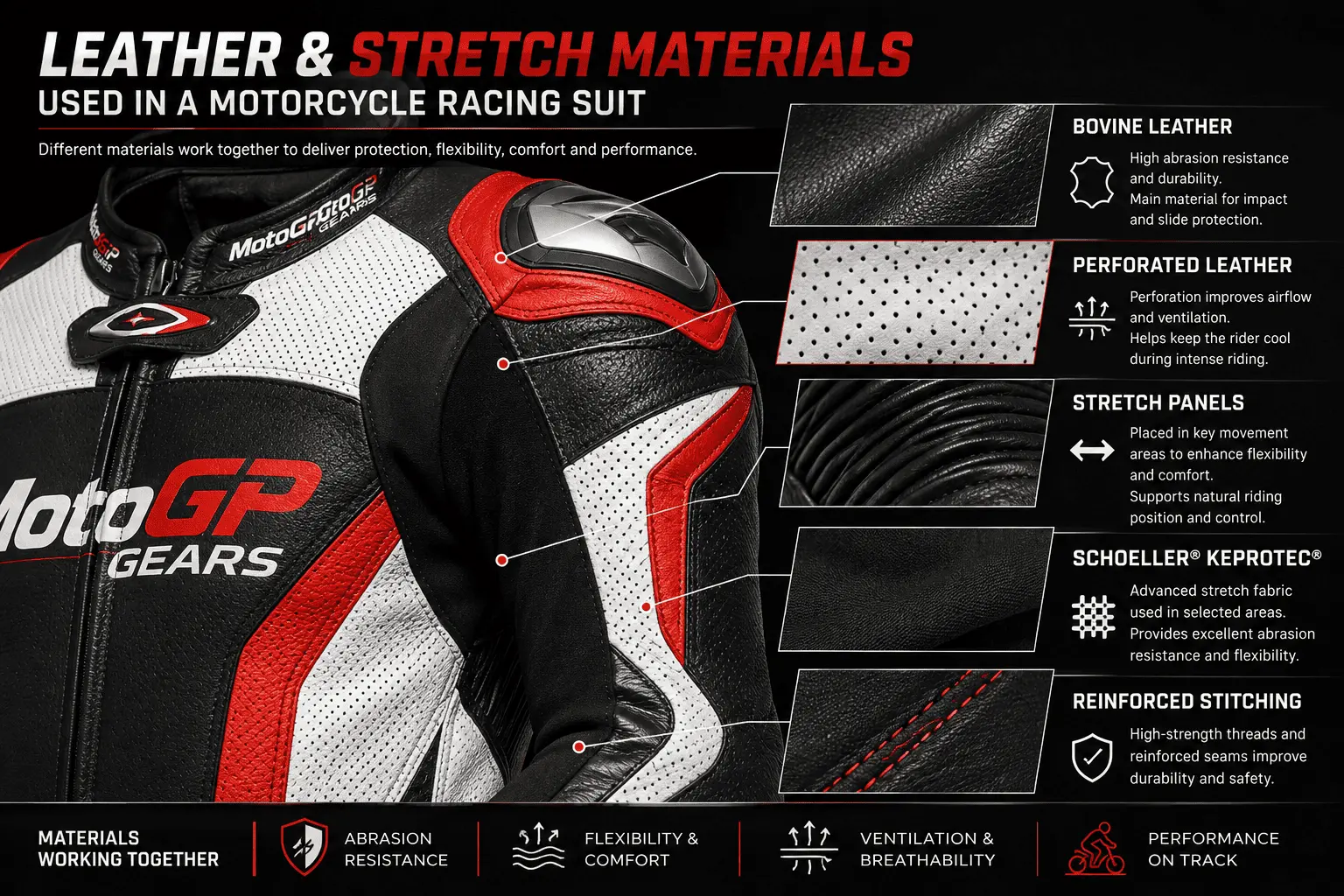
Material selection should be based on the riding application rather than the appearance of the garment. Leather and textile constructions have different characteristics, and the complete garment design matters more than the material name alone.
| Factor | Leather | Textile |
|---|---|---|
| Abrasion Characteristics | Commonly selected for performance-oriented motorcycle protection. | Performance depends strongly on textile type, construction and certification. |
| Track Focus | Common choice for dedicated racing applications. | Can be useful where textile construction is appropriate. |
| Flexibility | Stretch panels and ergonomic patterning are important for mobility. | Construction can provide flexibility through fabric and stretch zones. |
| Ventilation | Perforation and ventilation panels can improve airflow. | Mesh and ventilated textile construction can support airflow. |
| Weather Versatility | Can be less versatile in changing weather without suitable design features. | Some textile systems are designed around broader weather conditions. |
MotoGP Gears states that its motorcycle gear materials include bovine leather, with kangaroo leather also available for certain products, and uses technical materials such as Schoeller KEPROTEC in elastic sections.
Important: Do not judge a racing suit only by leather thickness, material name or appearance. Protection performance depends on the complete garment, construction, protective components and applicable testing or certification.
Motorcycle Racing Suit Armor and Protection
A racing suit should be evaluated as a protection system. The outer garment helps address abrasion and the protective components are intended to address impact in specific body areas.
| Shoulders Check protective coverage and whether the protector remains correctly positioned during riding movement. | Elbows Protection should remain aligned while the rider bends the arm into the normal control position. | Knees Knee protection should remain correctly positioned during riding posture and cornering movement. |
| Hips Check whether hip protection is included or supported by the garment. | Back Determine whether a back protector is included, removable or intended to be used separately. | Chest Check the actual chest-protection provision rather than assuming every suit has the same configuration. |
Key Point:
A suit described as having "armor" does not automatically tell you the protection level. Check the actual protector specifications, locations, certification markings and whether the protectors are supplied with the garment.
What Does CE Mean for a Motorcycle Racing Suit?
CE marking and the underlying conformity requirements should not be treated as a marketing phrase. Riders should identify the applicable standard, garment class and product documentation rather than assuming that every product described as "CE" provides the same level of protection.
For motorcycle protective garments, the European framework references the EN 17092 series. The EU's published harmonised-standard references include EN 17092-2 for Class AAA garments, EN 17092-3 for Class AA, EN 17092-4 for Class A, EN 17092-5 for Class B and EN 17092-6 for Class C garments.
| Standard | Garment Class | What the Rider Should Do |
|---|---|---|
| EN 17092-2:2020 | Class AAA | Verify that the actual garment is certified to the stated class. |
| EN 17092-3:2020 | Class AA | Review product conformity and intended application. |
| EN 17092-4:2020 | Class A | Check garment documentation and protection configuration. |
| EN 17092-5:2020 | Class B | Understand the class requirements and limitations. |
| EN 17092-6:2020 | Class C | Review the exact garment type and protective function. |
Certification Check: Do not use a generic "CE-approved" statement as a substitute for checking the exact product documentation, conformity information, protector certification and garment classification.
Standards and conformity requirements can change. Riders in Europe should verify the current documentation applicable to the specific product and use case before purchase or competition.
How Should a Motorcycle Racing Suit Fit?
A racing suit should be evaluated in the riding position, not only while standing in front of a mirror. The correct fit should hold protective components in their intended positions while allowing the rider to operate the motorcycle naturally.
| 1 | Check the Shoulders The shoulder area should feel secure without restricting normal control movement. Protective components should not migrate excessively when the arms move. |
| 2 | Check the Arms Bend the arms into a normal riding position. Sleeves should allow control movement without excessive bunching or pulling. |
| 3 | Check the Torso A race-oriented suit often feels different from a normal leather jacket because it is patterned around a forward riding posture. |
| 4 | Check the Hips The suit should allow the hips to move naturally while maintaining appropriate coverage and without excessive looseness. |
| 5 | Check the Knees Knee protection and sliders should remain where intended when the rider bends the knees and moves into a riding position. |
| 6 | Check the Complete System Test the suit together with gloves, boots and any compatible protective or airbag system that will actually be used. |
For Custom Suits: Accurate body measurements are especially important because made-to-measure construction depends on the quality of the measurements supplied. Review measurement instructions carefully and provide consistent measurements.
Motorcycle Racing Suit Sizing: What to Measure
Sizing should go beyond simply selecting your normal clothing size. Motorcycle racing suits are structured around riding posture and protective positioning, so body measurements are more useful than guessing from everyday clothing.
| Chest Measure around the fullest part while maintaining a natural posture. | Waist Measure around the natural waist without pulling the tape excessively tight. | Hips Measure around the fullest part of the hips and seat. |
| Sleeve Length Important for positioning the arms and protecting the wrists. | Inseam Important for knee and lower-leg positioning. | Torso Length Particularly important when evaluating a close-fitting racing pattern. |
When a standard size does not provide the required proportions, a made-to-measure racing suit can be considered. MotoGP Gears currently offers a custom racing suit product with made-to-order design and measurement-based customization.
Ventilation and Perforation
Ventilation becomes especially important during long sessions, warm weather and physically demanding riding. However, more perforation is not automatically better for every rider or climate.
| Option | Potential Advantage | What to Consider |
|---|---|---|
| Non-Perforated | More coverage against direct airflow. | Can feel warmer in hot conditions. |
| Front Perforation | Introduces airflow across the front of the body. | Consider temperature and riding conditions. |
| Back Perforation | Can support airflow through the rear. | Should be evaluated as part of the entire ventilation design. |
| Full Perforation | Maximum emphasis on airflow. | Not necessarily appropriate for every environment or application. |
MotoGP Gears product specifications show configurable perforation options on some racing suit products, including front, back, full or no perforation.
Motorcycle Racing Suits and Airbag Systems
Airbag systems add another layer of protection and should be considered before purchasing a close-fitting racing suit. Compatibility matters: the airbag system, suit pattern, available expansion room, closure system and manufacturer's instructions all need to work together.
Bottom Line:
Never assume that an airbag will work correctly with any racing suit. Follow the airbag manufacturer's compatibility, sizing, installation and activation requirements and confirm that the suit is designed or approved for the intended system where applicable.
Questions to Ask Before Combining a Suit and Airbag
- Is the airbag system intended to be worn inside or outside the suit?
- Does the suit provide the required expansion space?
- Does the manufacturer specify compatible suit designs?
- Can the rider maintain normal movement and control?
- Does the racing organization permit the selected configuration?
Airbag technology should complement—not replace—the correct outer garment, impact protection, helmet and other required protective equipment.
Racing Suit Construction: What Should You Look For?
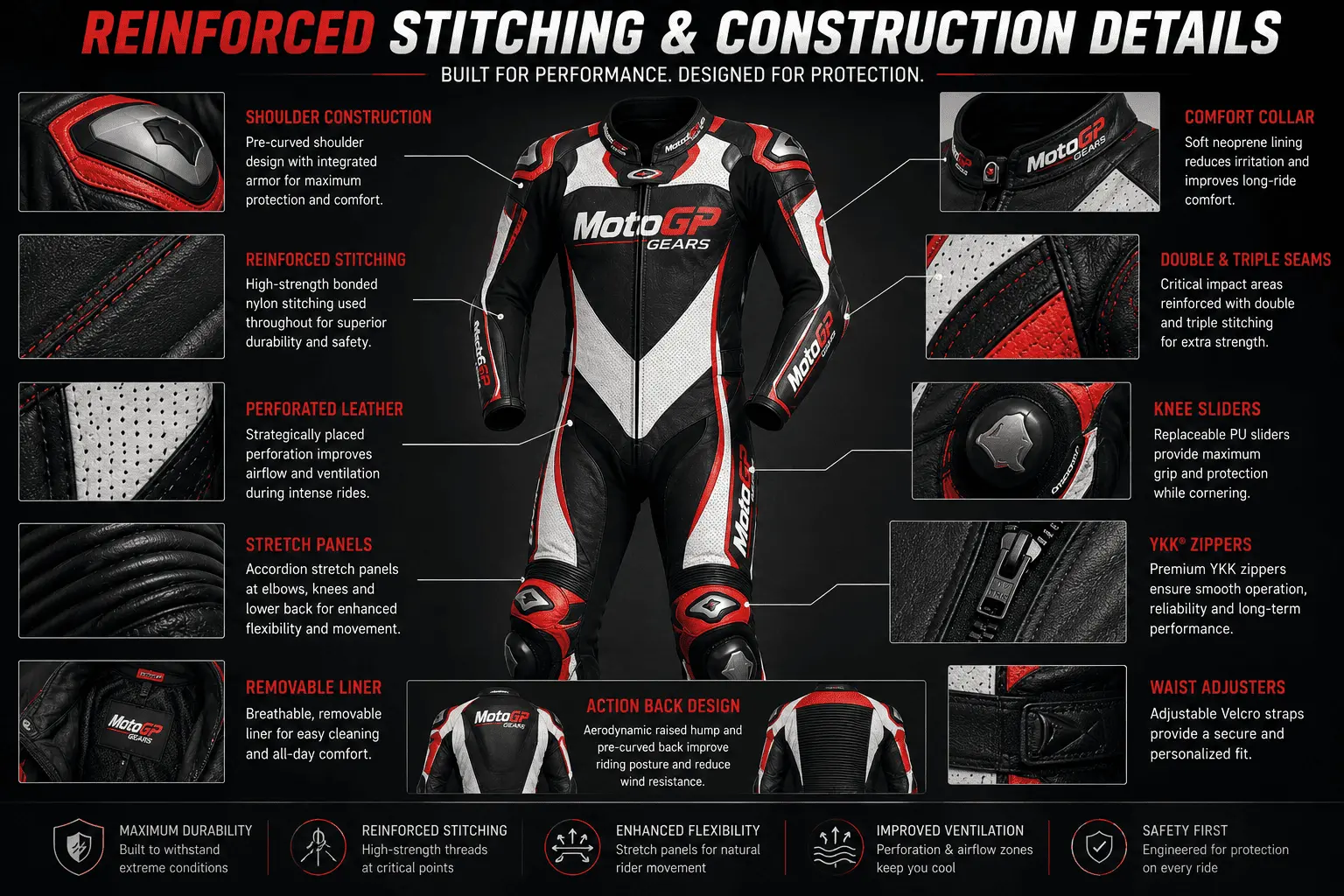
Two suits can look similar while having very different construction. When comparing products, look beyond the graphics and inspect the underlying pattern, seams, reinforcement, stretch areas, closures and protective architecture.
| Leather Panels Panel layout should support the rider's movement and intended use. | Reinforced Seams Stitching and seam construction are important parts of garment durability. | Stretch Zones Stretch material can help accommodate movement in the riding position. |
| Closures Zippers, cuffs and connection systems should function securely and consistently. | Lining A removable or breathable lining can affect comfort and maintenance. | Sliders & Hump Racing-oriented features should be evaluated according to the rider's intended use. |
How a Custom Motorcycle Racing Suit Is Made
Custom racing gear requires more than printing a design onto an existing garment. A useful custom process considers measurements, pattern development, material selection, construction, customization and final quality checks.
| 1 | Measurements Rider measurements establish the foundation for a made-to-measure pattern. |
| 2 | Design Specification Colors, graphics, names, numbers, logos and configuration requirements are established before production. |
| 3 | Material Selection Leather, stretch materials, lining, closures and protective components are selected according to the intended configuration. |
| 4 | Cutting and Assembly Individual panels are cut and assembled into the suit structure. |
| 5 | Stitching and Finishing Seams, closures, graphics, protective components and finishing details are completed. |
| 6 | Quality Control Finished construction and key details are checked before the product is prepared for delivery. |
MotoGP Gears Manufacturing Perspective
MotoGP Gears describes its manufacturing process as combining internationally sourced materials with U.S.-based production and finishing. Its published process discusses material sourcing, cutting, stitching, customization and quality control.
This makes the manufacturing process relevant when evaluating custom motorcycle racing gear because the final product depends on both the selected materials and how those materials are patterned, assembled and finished.
How to Compare Motorcycle Racing Suits
Price should not be the first comparison point. Start with protection, certification, construction and fit, then compare comfort, customization and additional features.
| Priority | What to Compare | Why It Matters |
|---|---|---|
| 1. Intended Use | Track, racing, sport riding or mixed use. | Determines which configuration makes sense. |
| 2. Certification | Applicable garment standard and class. | Provides a defined conformity framework. |
| 3. Protection | Shoulder, elbow, back, hip, knee and other protective components. | Different suits can use different protection configurations. |
| 4. Fit | Body measurements and riding-position fit. | Protection needs to remain appropriately positioned. |
| 5. Construction | Panels, seams, reinforcement, stretch areas and closures. | Construction affects durability, movement and usability. |
| 6. Ventilation | Perforation, vents and lining. | Important for rider comfort and heat management. |
| 7. Customization | Colors, graphics, names, numbers and measurements. | Important for teams, riders and personalized gear. |
| 8. Maintenance | Lining, cleaning and storage requirements. | Proper care can help preserve the garment. |
Custom vs Off-the-Rack Racing Suits
| Factor | Off-the-Rack | Custom / Made-to-Measure |
|---|---|---|
| Availability | Usually available in predefined sizes. | Requires a measurement and production process. |
| Fit | Based on standard size proportions. | Can be designed around rider measurements. |
| Design | Limited to available designs. | Can support personalized colors and graphics. |
| Team Identity | Usually limited. | Useful for names, numbers, logos and team designs. |
| Best For | Riders who fit standard sizing and want faster selection. | Riders prioritizing fit, personalization or specific configurations. |
MotoGP Gears currently offers a made-to-order custom racing suit with options for personalized design and rider measurements.
Design Your Custom Racing Suit
How to Care for a Motorcycle Racing Suit
Proper maintenance depends on the material and the manufacturer's care instructions. Avoid treating a technical racing suit like an ordinary fashion leather jacket.
- Follow the care instructions supplied with the garment.
- Allow the suit to dry naturally after use when it becomes damp.
- Avoid unnecessary exposure to high heat.
- Keep the suit stored in a dry, ventilated environment.
- Inspect seams, zippers, closures and protective components periodically.
- Check removable liners and protective components according to their instructions.
- Do not use aggressive cleaning chemicals unless specifically approved.
- After a serious crash, have the garment and protective components assessed before relying on them again.
If a manufacturer provides specific cleaning, storage or inspection instructions, those instructions should take priority over generic care advice.
Common Motorcycle Racing Suit Buying Mistakes
| Buying for Appearance Only Graphics and styling do not tell you enough about protection or construction. | Ignoring Riding Position A suit that feels comfortable standing may fit differently on the motorcycle. | Assuming CE Means Everything Check the actual garment standard, class and documentation. |
| Choosing the Wrong Size Excessive looseness can affect protective positioning and riding comfort. | Ignoring Event Rules Competition and track requirements can differ. | Forgetting the Complete Gear System Suit, gloves, boots, helmet and other protection need to work together. |
Continue Your Motorcycle Racing Gear Research
A racing suit is only one component of a complete motorcycle protection system. Riders comparing their options can also explore related motorcycle racing gear and manufacturer information.
- Motorcycle Racing Gear Guide — understand how suits, gloves, boots and other gear work together.
- MotoGP Gears Manufacturing Process — learn about material sourcing, construction and quality control.
- Motorcycle Gear Materials — review materials used in MotoGP Gears products.
- Custom Motorcycle Racing Suit — explore a made-to-order option for personalized racing gear.
Motorcycle Racing Suit FAQ
What is the best motorcycle racing suit for track riding?
The best suit depends on the track requirements, rider, fit, protection system and intended use. For dedicated track riding, a properly fitted one-piece suit is a common starting point, but the event's rules should always be checked first.
Is a one-piece motorcycle racing suit better than a two-piece?A one-piece suit provides an integrated construction and is commonly selected for dedicated track applications. A two-piece suit can offer greater versatility, but the connection system and event requirements need to be considered.
Is leather better than textile for motorcycle racing?Leather is a common choice for performance-oriented racing gear because of its abrasion-resistant characteristics. Textile suits can also be appropriate depending on their material, construction, certification and intended use.
What CE standard should a motorcycle racing suit have?Riders should identify the applicable motorcycle protective-garment standard and exact garment class rather than relying on a generic CE statement. The EN 17092 series includes Classes AAA, AA, A, B and C with different requirements.
What does AAA mean on motorcycle protective clothing?AAA is a garment class within EN 17092. It should be understood in the context of the standard's requirements rather than treated as a general quality score for every component of the riding system.
How tight should a motorcycle racing suit be?A racing suit should fit securely without restricting normal riding movement. Protective components should remain correctly positioned when the rider assumes the motorcycle riding posture.
Can I wear an airbag with a motorcycle racing suit?It depends on the specific airbag and suit. Always follow the airbag manufacturer's compatibility and sizing requirements and confirm whether the suit provides the required space and configuration.
Should a motorcycle racing suit be perforated?Perforation can improve airflow in warm conditions, but the appropriate amount depends on climate, riding conditions and intended use.
Are custom motorcycle racing suits worth it?Custom suits can be particularly useful when standard sizing does not provide the desired fit or when a rider wants personalized colors, graphics, names, numbers or other configuration options.
How do I measure for a custom motorcycle racing suit?Measurements commonly include chest, waist, hips, sleeve length, inseam and other body dimensions required by the manufacturer. Always follow the supplier's exact measurement instructions.
Can a racing suit be used for street riding?Not automatically. Suitability depends on the garment's actual design, certification, protection and intended application. Track-focused equipment should not automatically be assumed suitable for every road-riding situation.
What should I check before buying a motorcycle racing suit?Check intended use, event rules, garment certification, protective components, fit, construction, material, ventilation, airbag compatibility, sizing and care requirements.
Ready to Explore a Custom Motorcycle Racing Suit?
If standard sizing or off-the-shelf designs do not meet your requirements, explore a made-to-order racing suit designed around rider measurements, personalization and your intended riding application.
Standards note: Always verify the current certification, conformity documentation and competition requirements applicable to the exact motorcycle protective garment you are considering. Standards and regulations can change.
Write a Review
Latest Posts


Related Articles
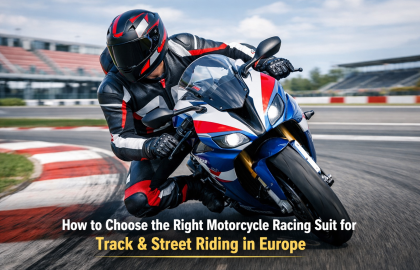
How to Choose the Right Motorcycle Racing Suit for Track & Street Riding in Europe
Learn how to choose the perfect motorcycle racing suit for safety, comfort, and performance. Discover leather...